
The Value of a Point of View
What Demna teaches us about cultural relevance, disruption and the power of reframing the familiar

Demna Gvasalia, known mononymously as Demna is a Georgian fashion designer.
Luxury often presents itself as timeless. In reality, it survives by remaining culturally relevant.
Few contemporary creative leaders have demonstrated this more clearly than Demna. Across Vetements, Balenciaga and now Gucci, his work has repeatedly taken objects associated with ordinary life and moved them into the luxury system: courier uniforms, shopping bags, trainers, tracksuits, rubbish bags and snack packaging.
Viewed without context, these objects can appear provocative for the sake of provocation. Studied more closely, they reveal a consistent methodology built around observation, cultural context and a willingness to challenge established definitions of value.
That methodology has long fascinated me. Not because I believe hospitality should imitate fashion, but because Demna demonstrates what becomes possible when a brand develops a clear point of view and applies it without apology.
It has influenced the way we think at Everything Now.
Context changes meaning
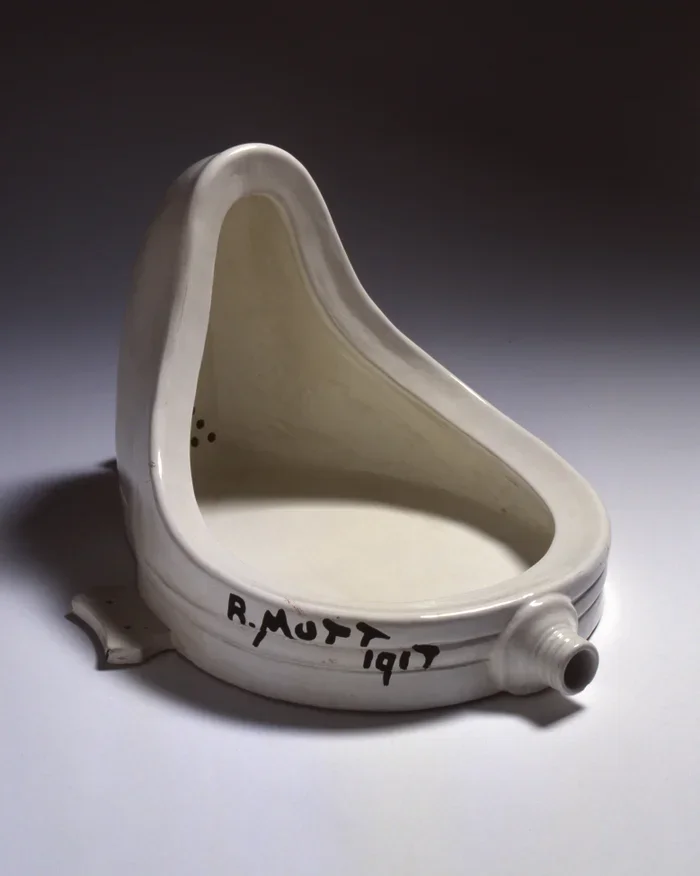
Marcel Duchamp's Fountain, 1917
In 1917, Marcel Duchamp submitted a mass-produced urinal to an exhibition under the title Fountain. The act became one of the defining gestures of modern art.
Duchamp’s readymades challenged the idea that artistic value depended exclusively on the physical manufacture of an object. A commercially produced object could become art through selection, authorship and context. The artist’s role was no longer limited to making. It could also involve noticing, choosing and reframing.
This principle matters far beyond the art world.
Context influences how people assign meaning. The same object can appear functional, ordinary, ironic or desirable depending on where it is placed, how it is presented and who gives it cultural legitimacy.
Demna applies this mechanism to fashion.
A bag resembling IKEA’s Frakta tote becomes a luxury accessory when reconstructed in leather and placed inside a Balenciaga boutique. A rubbish sack becomes a calfskin handbag. A DHL uniform becomes a runway garment. The shape remains familiar, but its materials, authorship and environment alter its perceived value.
The work does not simply ask whether these objects are beautiful. It asks why one object is considered valuable and another is not.
Personal history as a creative lens
Demna’s relationship with the ordinary is not purely theoretical.
He was born in Georgia and experienced displacement during the conflict in Abkhazia, leaving his home as a refugee. He has frequently described the experience of being an outsider as central to his identity and work.
His early life also shaped his relationship with Western products and symbols. Objects that appeared commonplace in Western Europe could carry very different significance in the post-Soviet environment in which he grew up.

IKEA-inspired bag
The IKEA-inspired bag is one documented example. Demna explained that he had used the original bag extensively as a student and had wondered what it might become if recreated as a beautiful luxury product.
This distinction is important.
The reference was not selected randomly from a collection of internet memes. It came from lived experience. A practical object carried personal memory, social meaning and recognisable design codes. His intervention changed its material and context, but preserved its familiarity.
That combination gives the work cultural depth. The audience recognises the object before it understands the argument.
Observation before invention
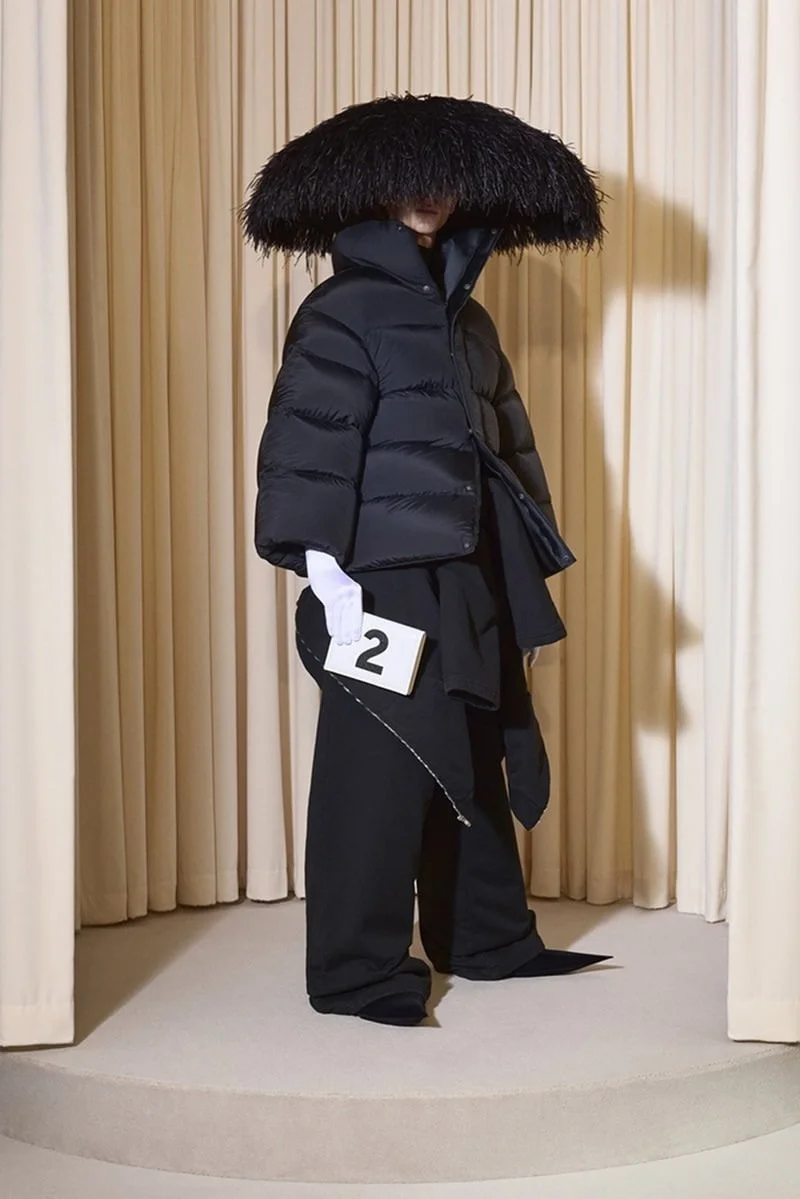
Balenciaga Couture 53
Demna has described an approach rooted in observing how people actually dress. He studies streets, popular culture, workwear and the visual codes of everyday life. Former Royal Academy of Fine Arts professor Linda Loppa has characterised his process as almost anthropological.
This helps explain why his work often feels simultaneously familiar and unfamiliar.
The starting point is not fantasy. It is reality.
Oversized hoodies, trainers, denim, corporate uniforms and inexpensive commercial packaging are already part of the visual landscape. Demna isolates these elements, exaggerates them, alters their proportions or reconstructs them using luxury materials.
The design process begins with recognition rather than decoration.
This differs from a traditional model of luxury in which the brand creates an elevated world removed from ordinary life. Demna collapses that distance. He brings the street, the supermarket, the delivery depot and the internet into the luxury environment.
The result has frequently been described as hyper-real rather than simply surreal. The work does not escape reality. It intensifies it.
Luxury as a question, not an answer
Traditional luxury has generally relied on a recognisable value system:
rare materials;
technical craftsmanship;
controlled distribution;
heritage;
exclusivity;
institutional prestige.
Demna did not eliminate those elements. His work often depends on sophisticated construction and material quality. He instead placed them in tension with forms associated with disposability, labour, mass production and low economic value.

The calfskin rubbish bag is effective precisely because both realities are visible at once. Its silhouette communicates waste. Its material and execution communicate luxury.
This creates a contradiction the audience must resolve.
Is the object luxurious because it is made from calfskin? Because Balenciaga produced it? Because it appeared on a runway? Because it is expensive? Or because enough people agree that it has cultural significance?
Demna’s work does not provide a definitive answer. Its value lies in forcing the question.
That is what separates disruption from novelty.
Novelty attracts attention by being different. Disruption exposes an assumption that had previously gone unquestioned.
The consumer is part of the work
These products also examine the relationship between branding and perceived value.
A familiar object reconstructed by a luxury house reveals how much meaning is created beyond the object itself. Name, distribution, cultural relevance, scarcity, communication and social recognition all contribute to value.
This is not unique to fashion. Every luxury category operates through a combination of functional and symbolic value.
A hotel room provides accommodation, but its market value is also shaped by location, architecture, service, history, reputation, belonging and the meaning attached to the brand. A cocktail contains ingredients, but its price is influenced by the room, the ritual, the people, the story and the cultural position of the venue.
Demna makes this mechanism unusually visible.
The consumer understands the reference. The consumer understands the absurdity. The consumer may even understand the critique. Buying the object does not place the customer outside the joke. It makes them part of it.
Virgil Abloh and the readymade

Off-White Style Replacement Shoelaces
Demna was not alone in bringing Duchamp’s logic into contemporary fashion.
Virgil Abloh developed what became known as his 3% approach: altering an existing object just enough to change its meaning. Rather than pursuing originality through complete reinvention, he used quotation marks, labels, exposed construction and small interventions to make familiar products appear newly legible.
The two designers applied similar intellectual foundations differently.
Abloh frequently used language and graphic framing. His quotation marks created distance between an object and its accepted definition. A shoelace labelled “SHOELACES” became both a functional component and a comment on the component.
Demna more often works through silhouette, displacement and material contradiction. The visual identity of the original object remains recognisable, while its scale, construction or cultural setting is transformed.
Duchamp asked what makes an object art.
Abloh examined authorship and remix culture.
Demna continues to ask what makes an object luxury.
Disruption requires education
One of the risks of challenging established codes is that the audience may see the gesture without understanding the thinking behind it.
A strong point of view therefore requires education.
Education does not mean explaining every idea until it becomes harmless. It means providing enough cultural and intellectual context for an audience to engage with the work on more than a superficial level.
Without context, the IKEA bag becomes an expensive copy.
With context, it becomes a study of personal memory, industrial design, status, material transformation and the mechanisms through which luxury creates value.
Without context, a rubbish-bag handbag appears cynical.
With context, it becomes a confrontation between disposability and permanence, low status and high status, utility and desire.
Brands cannot expect audiences to understand a challenging idea automatically. The more unfamiliar the proposition, the more deliberately its context must be built.
Challenging the norm is not the same as rejecting it
Demna’s work is sometimes reduced to anti-fashion, irony or provocation. That reading overlooks his engagement with traditional technique.
At Balenciaga, he returned the house to haute couture in 2021, decades after Cristóbal Balenciaga had closed his couture house. His work combined historic silhouettes and exacting construction with T-shirts, denim, parkas and other elements of the contemporary wardrobe.
This matters because effective disruption rarely comes from ignoring the rules.
It comes from understanding them well enough to decide which should remain, which should evolve and which no longer serve the culture.
Demna’s work relies on knowledge of fashion history, garment construction and the codes of luxury. The disruption gains authority because it is supported by competence.
The point is not to reject craft.
The point is to prevent craft from becoming the only idea.
The hospitality implication
Luxury hospitality is surrounded by established conventions.
The same language. The same imagery. The same rituals. The same claims of authenticity, exclusivity and personalised service.
Many of these conventions exist for good reason. Some have become automatic.
The opportunity is not to make hotels deliberately strange. It is to examine familiar elements with greater intelligence.
What does arrival mean now?
What makes an experience feel local rather than simply themed?
What creates status for a new generation of luxury travellers?
Which inherited rituals still carry meaning?
Which ordinary elements of daily life could become memorable when reframed through design, service and context?
A point of view begins with these questions.
Demna’s career demonstrates that culture does not move forward through consensus alone. It moves when someone understands the existing system, identifies an unresolved tension and gives it a visible form.
That is the real lesson.
Not provocation for attention.
Not difference for its own sake.
A position, built on context, expressed with clarity and carried through with enough conviction to change how people see what was already in front of them.
Yamil Errasti / Founder
And yes, this was probably written faster than it should have been with the help of ChatGPT.
Sources
Kering, “Demna Appointed Artistic Director of Gucci.” Kering
Kering, “Gucci: The House and Creative Vision.” Kering
Balenciaga, “50th Couture Collection.” Balenciaga
Museum of Modern Art, “Readymade.” The Museum of Modern Art
Museum of Modern Art, “Marcel Duchamp and the Readymade.” The Museum of Modern Art
Museum of Modern Art, “Marcel Duchamp: In Advance of the Broken Arm.” The Museum of Modern Art
Vogue, “Demna Reflects on His Decade at Balenciaga.” Vogue
Vogue, “Demna Gvasalia on Balenciaga, Haute Couture, and Why He’s Staying Put in Zurich.” Vogue
Kering, “Balenciaga Appoints Demna Gvasalia as Artistic Director of the Collections.” Kering
