
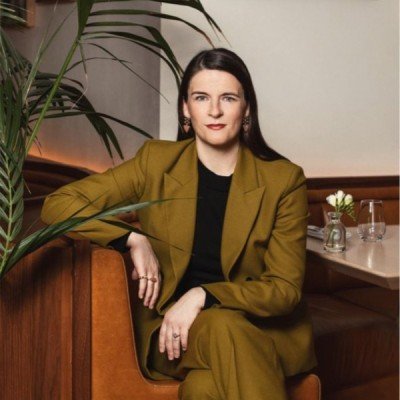
A conversation with Julie Van de Kerckhove
Frequency Interviews No. 01
Yamil Errasti and the Everything Now team
Julie is a friend I deeply respect and find inspiring. We’ve known each other for almost a decade, and I’ve always admired how she combines strong leadership with personality, warmth and a real love for hospitality.
I invited her to open a series of leadership conversations at EN. I want the whole team to have references beyond our walls, people with different experiences they can learn from, relate to and ask about finding their own way to lead.
I started the conversation, and the team brought their own questions. Julie spoke openly about ambition, frustration, confidence and the people who helped her find her voice. She also reminded us that growing as a leader doesn’t mean becoming someone else.
I hope you find it as interesting and inspiring as we did.
Yamil & the EN team
Yamil: Rather than going through your CV, how would you describe your journey as a leader?
Julie: I grew up in hospitality. My parents ran a restaurant when I was a little girl, so I think I just have it in my veins somehow.
I would split my career into four leadership moments. I was 20 when I had my first job in London. Those first six to eight years, I was a very young leader: very assertive, very ambitious, very direct. I learned a lot by error, banging my head against the wall and standing up again.
Then I became a more mature leader and increased my empathy towards others. It wasn’t so much about what I wanted anymore. It was about what the person or the result needed. That’s when you start learning a lot from mentors. You start asking: “Wait a minute. How can I do this better?”
The third stage was becoming a General Manager. You’re responsible for the results, the owners, a whole team of employees, a building. You have to listen, take the input and make decisions for all your stakeholders.
After about ten years as a General Manager across four properties, I decided to take an above-property role. Now I have indirect authority over multiple projects, initiatives and people. It took time to understand how to translate my experience into something people perceived as valuable.
Yamil: What was hardest about moving from direct authority to indirect authority?
Julie: You need to readjust your whole mindset. You can’t decide for other people. You need to convince them and show that your initiatives will bring value to what they want to do.
You need to learn how to be pushy, but not bossy.
You’re still responsible for the outcome. Whether a person believes you have the right idea or wants to make the investment, you have to build the credibility, the arguments and the initiatives to move it forward.
Yamil: How do you build that credibility?
Julie: By following through on whatever you set out to do.
I’ll give you an example. Across one of our Luxury brands, we had hotels with fantastic brand positioning but operational execution issues, and others with fantastic guest satisfaction but very little happening around positioning and experiences.
I wanted to bring those things together through a boot camp, working with our quality-assurance partner and our brand leaders. What does great positioning look like? What are our communication pillars? How do we translate those into experiences?
It took a lot of work to get everybody in the room and convince people to make it happen. But the General Managers left with something concrete they could take back to their hotels and execute with their teams.
You see something, explain it and create an initiative that actually drives change. That builds credibility.
And if you don’t have an answer, that’s fine. But if I say, “Listen, I’ll get back to you,” I do get back to them, regardless of what’s happening.
Yamil: What does adding value mean in a role like ours?
Julie: It will be different for every project, but the big thing for me is proactivity.
You start with a defined idea of what you’re there to do. But a project will evolve. If you can listen to your stakeholders, understand that it is shifting and adapt by bringing solutions and ideas, that’s where you bring real value.
Maybe a peer doesn’t align with what you’re trying to do. Maybe you don’t get the budget. Maybe some hotels don’t want to participate. You have to ask: “How can I find another motivation for this person? How can I make this interesting for them?”
Be hands-on. Own the result of what you’re doing. Keep focused on the outcome.
Yamil: How do you deal with the frustration when something you believe in isn’t moving forward?
Julie: Not easy! I’m very passionate. I’m a bit of a control freak as well, by the way. If people don’t do things exactly the way I want them done, I do get frustrated.
What I’ve learned is to take a step back and ask: “What am I trying to achieve with this team? What is ultimately the goal?”
Sometimes you’re frustrated with one person rather than with the whole project. Maybe you need to spend more time with that person on the phone and understand what’s happening. Tackle that directly rather than getting frustrated with the overall thing.
Yamil: And personally? What helps you step away from it?
Julie: I’m a disfrutona. I like to treat myself, to be honest.
I’ll go home and say to my husband, “Let’s crack a bottle of champagne.” Or I’ll buy a pair of shoes, book a trip with my son, hang out with my friends. I’m not a sporty person. I just love to enjoy things.
My husband also helps me be a little more pragmatic and less emotional. Sometimes he says, “Just calm down. It’s okay.” He’s not necessarily right, but in that moment, that’s what I need.
Don’t take your frustrations to somebody who will wind you up. Find the other person.
Sophie: Was there a moment that helped you start trusting your judgment?
Julie: This is where the mentors come in.
When I was very young, I almost gave up on hospitality. I was two jobs in, very passionate, running too fast for my own good. I didn’t necessarily have the right leader to help me find my voice.
I took a small break and followed my husband to Paris. I started looking at jobs in other industries. Through a connection from Brussels, I ended up meeting a General Manager at Marriott, who offered me an assistant role.
And that’s where I found my home.
For the first time in my career, I worked with leaders who actually cared about my development. People who mentored me and gave me a voice.
You have to tell your leaders what you need, what you’re struggling with, where you’re not finding a way to get your message across. And also: “This is where I’m really happy. This is my happy place. I want to do more of this.”
The leaders in the group need to make sure you get that voice.
When I found my people and a place where I could grow, my career skyrocketed. So, find your people.
Laura: What is the most important quality to develop as a leader today?
Julie: I’ve worked a lot on this in myself. I’m quite ambitious. Every time I took a role, I was already thinking about the next two years, the next two years, the next two years.
I became frustrated with my own advancement. When you have that ambition in your head, you forget a little about the now.
Focus on what you’re working on now. If you do a good job and learn what you need to learn, the rest will come.
I’ve had to say to myself: “Okay, Julie, stop being so pushy. Make sure what you’re doing now brings actual value to people. Be there for them.”
We’re always thinking, “What’s next?” We also need to respect what we’re doing now and for whom we’re doing it. For the team, for our clients and for ourselves.
Alex: How do you bring a team together around that proactive mindset?
Julie: As a leadership team, you need a vision. I don’t want to turn this into corporate blah blah, but you do need to know where you want to take the team this year and in the next two years.
Then you need to understand how everybody can contribute and find their place. The tactics and initiatives will constantly change.
And it goes beyond the technical aspect. What are people’s human skills? Who’s the fun one in the office? How do you bring that person into the configuration to create a little bit of a vibe?
My regional team is an eclectic mess of personalities. We bring very different things, but we know exactly where we’re taking the region.
Find what everybody can bring to the group. Enjoy working together. And if somebody isn’t happy, talk it out. In a small team, you need to be connected. If something is starting to hurt, deal with it straight away.
It sounds easy, but we all have our day-to-day. Talk to each other. Help each other. Be kind.
Patricia: What helped you become more confident at work?
Julie: Believing in myself. I don’t have a big ego, but I have always believed I had something to bring.
When you feel doubtful, ask yourself: “Why am I reacting this way? Why does this hurt?” Then remind yourself: “Maybe I’m not the best at this, but I have things to bring to the table as well.”
Don’t be afraid to fail. It’s normal. The important thing is how you pick yourself up afterwards.
And don’t be embarrassed to own up to a mistake. I’m the first one to say, “Guys, I’m sorry. I shouldn’t have reacted like that. Here is what I was thinking.”
I’m also somebody who needs reflection. Some people are very verbal and have an answer straight away. I never have that. So don’t be afraid to go back and say, “Hang on. I didn’t exactly say what I meant. This is what I wanted to say.”
Experience brings credibility, maturity and confidence. It takes a bit of time.
Yamil: Are you kinder to yourself now?
Julie: Much more. I’m still very driven. I still want excellence. But I’ve stopped beating myself up and feeling guilty.
I have two boys. When they were little, I always felt guilty about spending too much time at work. Then you spend time on your personal life and feel you’re not spending enough time at work. You get into that little spiral.
I have girlfriends who are stay-at-home mums and others who have big careers or their own businesses. Everybody has a different type of guilt.
That’s why I say we need to support each other, whatever choices we make. Find people who are kind to you. You’ll be kinder to yourself as well.
Alex: How do you switch off when you love the work and could keep going?
Julie: I feel you. I have that syndrome all the time. I can work non-stop.
Find things you love. My children ground me a lot. They’re teenagers now, so if they give me five minutes of attention, I stop everything straight away!
Don’t put pressure on yourself. If you enjoy working on a project all evening for one night, that’s fine. If you don’t feel happy opening your emails, shut them down and do something you enjoy. Go out with friends, eat a pizza, cook.
Be conscious of how you feel about the workload and your life. It’s different for everybody, and everybody is at a different stage.
Alessio: What can men do to better support women in their careers?
Julie: First, don’t stereotype.
I’ve heard people say, “Female leaders are trending right now. Everybody is looking for female leaders.” Don’t do that. Don’t put people in a box.
And in your personal life, support the women around you. If your partner is very engaged in her career, or is working through questions about family and work, don’t make her feel guilty.
Women need to support women, too, whatever direction they take in their careers or their lives. In the end, we can all learn from each other.
Yamil: Is there anything you would go back and do differently?
Julie: Not really. I’m proud of the mistakes and the ups and downs because they brought me to where I am now, and I’m happy where I am.
I’m happy I went through those things. Even when I think about the guilt I felt when my children were small, I wouldn’t go back and say I want to do everything differently.
You have to go through the process. That’s how you learn and mature.
Enjoy the now. Make sure you feel good about the environment you work in and proud of what you’re doing. Ask yourself: “Do I enjoy this? Do I love my colleagues?” Nurture yourself with that.
Yamil: You’ve spoken about finding your own voice. How do you protect it as you become more senior?
Julie: Be yourselves. Don’t copy other leaders because you think they’re the best and you should be exactly like them.
I had a conversation with my Regional Vice President last year. He told me I needed to be more direct.
And I said, “Listen, that’s not my leadership style. I have my ways, you have yours.”
His way works for him. But if I started copying it, I would look ridiculous and lose myself.
Just be you. That’s more than enough.
Alexis: How do you find your balance between directness and empathy?
Julie: Look at how people react after you tell them something. Does the feedback have the outcome you intended?
If it does, it’s working. If it doesn’t, adapt and find another way, with your own personal style.
People have described my approach as an iron fist in a velvet glove. I bring the message like a little bump in your back: you feel it, but it doesn’t hurt.
But it’s different for everybody. The person in front of you won’t always respond to the same approach.
Before leaving, Julie asked the team to spend another five or ten minutes reflecting.
“Write down what stuck with you. Something you might want to do for yourself or for your colleagues. Maybe you’ve been hard on yourself lately. Think about why that is and how you could do it differently.
“Even for me, this conversation is inspiring. You always take something away from everybody.
“Take something from this conversation for yourselves.”
About Julie
Julie Van de Kerckhove is a senior operations leader at Marriott International, based in Barcelona. Her hospitality career spans more than two decades across London, Brussels, Paris and Barcelona, including General Manager roles at Renaissance Barcelona and The Barcelona EDITION. She now works at regional level, supporting hotel leaders and teams across multiple properties. LinkedIn
Having grown up in her parents’ restaurant, Julie brings a lifelong connection to hospitality and a personal commitment to helping people develop their confidence, judgment and leadership style.
